
by Kari Hensien | Mar 15, 2018 | Business Intelligence, RizePoint
Buzzwords such as big data, data analytics, and business intelligence are constantly making headlines. It’s easy for smaller businesses to dismiss them as passing trends that wouldn’t really help the bottom line, but the market for these kinds of tools continues to grow (the big data and analytics market itself is expected to be worth $22.8 billion by 2020), and it’s growing for a reason. About 78% of enterprises agree that collection and analysis of big data have the potential to change fundamentally the way they do business over the next 1 to 3 years.
While some of the growth has begun to slow, research leader and advisory company Gartner, Inc. believes it’s because business intelligence tools have become more mainstream and plenty of companies are already using them. Companies of all sizes are finding the benefits of tools that turn their data and information into rabid fans and fierce profits, but can business Intelligence really help all kinds of companies, even the smaller ones?
Enterprises are adopting business intelligence tools and using data to make decisions, but helpful, well-organized information isn’t just the big guys — data-backed decisions can promote growth for any size of business. Here are the ways business intelligence tools are making huge impacts for all kinds of businesses.
Improved Customer Relationships
According to IDG, the number one goal of companies using data analytics is to improve customer relationships. Understanding customer wants, needs, and desires is the key to developing products and services that interest and captivate them. Using business intelligence tools, businesses can identify trends among customers, better understand their buyers, and use that information to develop the solid, lasting relationships that lead to sustained profitability.
More Innovation
Innovation and creative thinking doesn’t come from a vacuum, and data can help inform new ideas and give better direction to existing ones. Business decisions are no longer made without data to back them. When companies use business intelligence tools to drive decision-making, there are no risky decisions, only carefully calculated ones. According to Forrester, business intelligence leaders say that reporting continues to be the strongest driver of innovation for their firms. Data analytics tools can uncover unseen potential by pointing to process improvements people may have overlooked and by helping companies identify products and services that solve customer problems they may not have even been aware of.
Faster Decision Making
Some of the most successful companies are ones that can make decisions fast and act on them faster. Customer wants and needs change as quickly as the market does, and companies that adapt the quickest can benefit from market changes rather than being destroyed by them. According to Bain and Company, companies that use analytics well are expected to make decisions five times faster than their competition. This means data and business intelligence tools offer more opportunity for companies by enabling them to think fast then act faster.
Better Internal Coordination
Business intelligence tools don’t just help companies find ways they can improve products and services for customers, they can also uncover better ways for a company to communicate and coordinate internally. Questions like: “Where are the bottlenecks?” and “What processes can be improved and how?” aren’t so easily answered by unstructured data. Business intelligence tools allow decision-makers to organize information and get an eagle-eye view of where internal processes can be improved so that they can streamline operations and even anticipate issues, rather than just respond to them.
A Stronger Edge and Better Profitability
Taken together, the various benefits of business intelligence tools give businesses an amazing edge over their competitors and the ability to thicken margins. With BI tools, data is no longer unstructured and messy, it’s understandable, organized, and most importantly, actionable. Companies with BI tools can make decisions more quickly, understand their customers better, and take actions that benefit the company from top to bottom. Better operations, happier customers, and more innovative products all lead to better profitability as well as firm footing on the high ground above your competition.
by Whitney McCarthy | Jun 1, 2016 | Business Intelligence, RizePoint
A new company and a new direction bring great changes to our customers. On May 23, 2016, we held a customer webcast where we talked about the new features and enhancements to the RizePoint platform and Mobile Auditor.
New User Interface
First things first. With a new company, comes a new look. It’s been obvious that the focus on improvements in the product to-date has NOT been in the UI. As enhancements and best practices continue to improve the user experience on personal devices, we know that enterprise tools must be user-friendly, too. You can see we’ve introduced a fresh look and cleaner navigation at the top of the web portal.
We’re excited for you to experience RizePoint with a whole new look. Mobile Auditor (our new mobile auditing app that shipped January of this year) also underwent a new set of clothes. We were able to keep all of the core functionality in the app, but make finding those features easier and more pleasing.
As a product team, we’ll continue to make the user experience a top priority so the content makes sense to you as a customer.
Management Dashboards
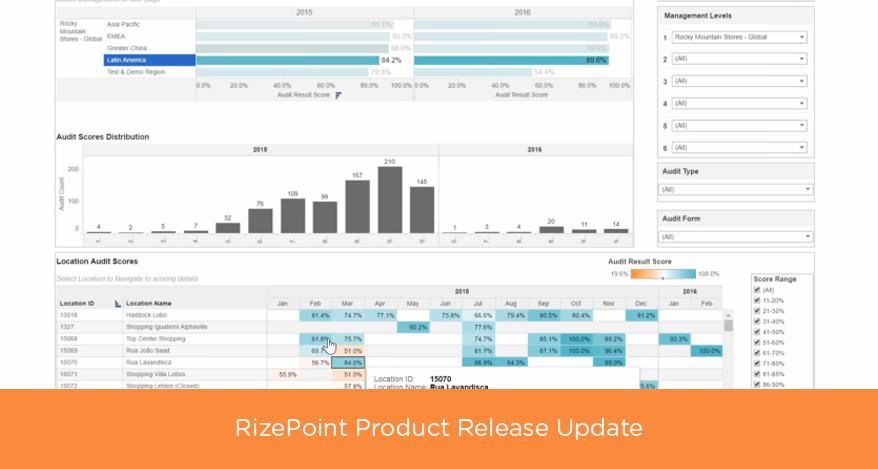
Now on to the largest part of this release. Having the right visibility into data to make decisions is important. Phase 1 of the process is where Directors, Property Managers, District Managers, or VP’s spend a large amount of time hunting for the results of completed assessments. After they get their hands on the information they need, Phase 2 begins. Sifting through mounds of data to compile into spreadsheets. YUCK!
RizePoint understands this pain and we’re now including out-of-the-box dashboards that we’ve built for you. All you need to do is login and start consuming (with a little bit of setup at the beginning).
Here’s a preview of each dashboard:
Scoring Dashboard
This dashboard is focused on showing overall percentage score trends based on management hierarchy and location level. There are two drill down reports: 1) Drill down for RATINGS from the Management Audit Scores on Main Dashboard showing rating trends and location details; 2) Drilldown to Location Scoring Details to see scores for a specific location – average overall, audit category, and report category scoring.
Non-Compliance Dashboard
This dashboard focuses on non-compliant response counts and percentages at varying levels of view such as audit form, audit type, report category, audit category. There is detail provided to see which questions were most non-compliant, including the findings (pre-defined comments) associated to the question. Drill down sub-reports are available to see more details on locations that missed the question, count of findings associated, answers tied to non-compliance, and questions tied to findings.
Corrective Action Management (CAM) and Action Plan Dashboards
CAM Dashboard works with the CAM feature, while the Action Plan Dashboard works with the action plan executive summary feedback report. These dashboards focus on days overdue, coming due, and due with regards to action plan ITEMS defined. There is a drill down report to look further at trends related to in-progress and completed ITEMS. Detail level provides review by locations with drill down available to look at the ITEM detail that defines the action plan and date attributes.
CAM Approval Dashboard
The CAM Approval dashboard is related to CAM feature for approving corrective actions. It displays plan information related to approval steps and durations by location. It has drill down reports to details about the steps and question comparisons for durations.
Auditor Dashboard
The auditor dashboard provides insight into audit companies and auditors conducting the audits – counts, scoring average audit duration, ratings, and types of audits. It has drill down to see audit category and report category score information by audit company or auditor. It also has a drill down to see more details around the auditor scoring – trends based on day of week and month of year.
Training Videos and Documentation
We’ve created a set of short videos that go over Management Dashboards and walk you through how to use them HERE. As always, you can access our documentation for step-by-step instructions on how to use various features.
About the Author
As Vice President of Product, Tim Harris leverages nearly 20 years of cloud-solution product leadership to drive RizePoint’s industry-defining products. Harris joins RizePoint from inContact, where he was Vice President, Product Management and Principal Product Owner. There, he was responsible for ensuring the coordination and continued creation of a unified cloud platform. Prior to this, he was instrumental in the product development workflow for inContact in his roles as Sr. Director of Product Management, Sr. Director of Cloud Ecosystem, and Director of Cloud Solutions. Harris holds two patents related to Business Communication and Call Routing.

by Di Lewis | Feb 11, 2016 | Business Intelligence, RizePoint
Today’s evolving world demands a lot from businesses. While you’re doing all you can to keep up with the fast pace of the
outside world and your growing industry and meet customer demands, your business is also required to maintain compliance with all your industry’s regulations. Compliance software is an efficient way to stay on top of all your compliance needs and satisfy your customer demands.
But, some companies don’t think they really need to implement compliance software. If this is your current mentality or if you’re on the fence, here are 10 signs to convince you that your business needs compliance software.
1. Customer satisfaction is low.
No matter your market, today’s business landscape is a consumer-centric one. So if your customer satisfaction is low, it’s time to take action to drive your customer satisfaction rating up. You not only need to be compliant in the sense of safety and legal reasons, but to please your customers and drive revenue.
When you don’t provide customers with pleasant experiences, you’re going to lose those customers and potential ones because of others’ bad experiences. Whether it’s a lack of effective communication about compliance standards and operating procedures, inability to maintain compliance consistencies across locations or not being able to regularly monitor what’s working and what’s not in terms of compliance, the right compliance software positively impacts your company’s overall performance and compliance, which in turn improves your customer satisfaction.
2. Customer numbers are dropping.
Many of today’s customers won’t do, or continuing doing, business with a company unless they have a compliance program in place.
A lot of emphasis is placed on better business practices. Implementing a compliance management system could be what allows you to get a new customer and turn them into a loyal customer. You need a compliance program to make sure your company doesn’t violate your customer program, and automated compliance software is an affordable way to implement your compliance management system.
3. Safety breaches have occurred.
Have you ever had a breach in food safety? Or failed a health inspection? If you answered yes to either of these, then you desperately need a food safety and quality management system.
This system makes sure your business complies with each food and safety regulation, during each step of the process. It saves time when it comes to tracking your processes and products, and allows you to aggregate all your data and create clear, effective safety audit forms.
4. You’ve paid thousands of dollars in penalties.
Non-compliance leads to monetary consequences and damages with your brand’s reputation. It could cost you thousands of dollars in fines and other repairs if you’re caught being non-compliant.
Compliance software is the solution you need if you’ve found yourself on the wrong side of the law one too many times. It ensures you stay on top of your operating procedures and every compliance detail, to keep your staff and customers healthy and safe, and keep your business away from unwanted monetary penalties.
5. Current process is time-consuming and costly.
Maintaining compliance is a complex, costly and time-consuming ongoing process. But with compliance management software, it’s not.
Software boosts your overall process. It reduces the time it takes your business to get and stay compliant, resulting in less money and other resources spent working on compliance procedures. It provides a more efficient way to track your compliance of quality and safety inspections, know what actionable steps to take to improve your operating procedures and improve communication amongst employees, all of which saves you time and money by providing a more proficient way of handling compliance.
6. Things aren’t clear across the board.
Without transparency and visibility into company operations and open communication amongst departments and company locations about proper business standards, consistent compliance isn’t possible. Everyone needs to be aware of company operations and what compliance regulations are to be followed.
Compliance software keeps everyone up-to-date on all things compliance related. From your COO to your regional managers to your 9-5 employees to your stakeholders, effective communication is possible. Standards and other pertinent information are kept clear across the board with customizable emails, role-based notifications and real-time data. Compliance software seamlessly keeps everyone on the same page and on a unified compliance front.
7. Unaware of any compliance gaps.
No business or its employees are perfect. Mistakes are bound to happen, and even with every careful step you take, your business runs the risk of having gaps in compliance.
Compliance management software proactively works to safeguard your compliance. You need to act fast in order to correct compliance issues before they become expensive liabilities. This kind of software system immediately notifies you when a compliance gap is found and then creates a real-time action plan, providing a plan fit for your company so you take the right measures to fix the problem.
8. Productivity is down.
How productive your employees are is in direct correlation with how profitable your business is. If your employees are wasting half of their workdays dealing with manual compliance processes and sifting through trivial emails and data, office productivity is sure to be down.
Compliance management software was designed to boost employee productivity. It streamlines company processes and employee tasks. When employees are properly trained on how to use the system and understand all the benefits of using it, your productivity and profit will rise.
9. Your policy management is disorganized.
Who has time to keep track of hundreds of paper files of various policies? No one. You don’t have the time or the space either. But, policies are still important, and managing them in an organized manner is something you have to do.
Software makes it easier to keep track of every policy and stay organized doing so. Some even let you manage a policy through its entire lifecycle. You can create and submit policies for editing or approval, and then once approved send them out to the applicable employees all from within the software.
10. You have a compliance audit coming up.
You want to pass your compliance audit, not fail it. And you don’t want to make the process harder than necessary for the auditor coming to perform your company’s audit.
Automated compliance software ensures better audit management. Your business and industry are constantly changing, and an automated platform allows you to quickly make changes and keep your audit forms up-to-date in real-time. It also means increased auditor consistency and guarantees each of your business locations receive a quality evaluation.
Convinced you need compliance software yet? Because as we’ve shown, only good things can come when your business implements this software.

by Di Lewis | Oct 23, 2015 | Business Intelligence, RizePoint
Many companies dedicate a lot of time and resources collecting large amounts of data, but unfortunately allow it to go into a black hole. Data capturing should be utilized to drive positive change. Otherwise, why do it?
Here are four possible reasons why ineffective data capturing occurs, and ideas on how to avoid the pitfalls.
- Collecting too much data. A company can only use so much information so they need to prioritize and collect only data that they intend to use. I’ve seen operational excellence forms that contain hundreds of questions. After doing a deep dive with the VP of operations, we determined that more than 25 percent of the questions were not important — and that no one was even looking at the results. So this company removed those questions, which produced a feedback report far more meaningful. Those responsible for taking action were less overwhelmed and saw more value in what they were acting on.
- No culture of follow-up. There’s no buy-in at the C-level that taking action is critical. C-level executives must set the example and take action after receiving high-level business intelligence information. If the leaders don’t take action, no one else will. Everyone will assume “no one cares.” It’s much easier for a C-level exec to take action if they have detailed, enterprise-level dashboards and reports to base decisions on. As you can imagine, a CEO or COO doesn’t have time to sort through volumes of data. Customized dashboards help them get the key information they need in real time.
- No rewards or incentives to encourage follow-up. And/or there are no repercussions if the follow-up doesn’t happen. In other words, no one is held accountable. Many times I’ve asked managers the question, “What happens if a location has repeat critical violations?” I often get a blank look or they say, “Ummmmmmmm… I’m not sure,” or “Nothing happens.” Nothing happens? Really? If a restaurant manager knows that “nothing will happen” if he or she doesn’t follow up, then guess what — this manager typically doesn’t follow up. At some point there has to be repercussions if critical violations are not addressed. For example, if a franchisee “fails” an inspection they may be required to foot the bill for a re-inspection. On the flip side, a rewards or incentive program for those who do follow up in a timely manner can really drive improvement. But the incentive doesn’t necessarily have to be monetary. Companies can get creative on how they reward managers who have strong track records of follow-up.
- The systems for capturing data are antiquated. Outdated data-capturing methods or systems don’t allow for easy action. These methods include using a pen and paper or an electronic spreadsheet, which are less than user friendly. Just last month I was talking to a contact at a restaurant chain that had a location actually shut down by the health department. I recommended that they implement a self-inspection program to encourage managers to be more proactive. They shared with me that managers are required to do self-inspections, but the reports are done on paper and just get filed away. No one sees them or reacts to them. They agreed this is really a waste of their manager’s time if no one is going to follow up. This is a perfect example of how an automated data-capture platform could make this process easier and more user friendly. An automated process would allow the reports to be more visible to various levels of management and would also allow for automated notifications to go out to those responsible for follow up.
Bringing data to life can drive positive results throughout the entire organization. Capturing data just for the sake of having it is a waste of time. Capturing meaningful data in a user-friendly platform like RizePoint is valuable and will take you to the next level. Click here to learn more!

by Di Lewis | Sep 11, 2015 | Business Intelligence, RizePoint
Whether you’re a business owner or a manager in your organization, you know the complexities of trying to assess the big picture of how your business is operating on a day-by-day (or even task-by-task) basis. In today’s data-driven business environment, there is simply too much data to manage manually—in a spreadsheet or similar fashion.
Why should you consider business intelligence performance management software? We’ve identified 3 key immediate benefits.
- Simplify and Save
Business intelligence software will save a tremendous amount of time, by simplifying the process of collecting data from all your departments and reporting your data in a format that’s easy to read and digest. Typically the tools in your general computer office suite don’t offer the right tools to accurately capture and analyze your data in real time. With so much on your plate, business intelligence performance management software can dramatically improve how your view and manage everything about your job.
- On-Demand Data
You’re busy. You’re dealing with all types of real world issues, and you certainly can’t spend your day pouring over databases and spreadsheets of information. However, imagine how much easier this type of real time assessment would be if you had a completely accessible business intelligence software system that you could access from your mobile device, any time. Any day.
- Customizable
Now, go even a bit further and imagine that business intelligence performance management software could be fully customized for your requirements. You could track and record the data that you needed in one integrated system that automatically populated all the reports, charts and graphs that required that data.
- Alerts to Keep you Informed
You control when and how you see your reports and data, and you can set alerts to automatically signal you with when threshold levels were met or were not met, depending on what you’re tracking.
- Collaborate
Business intelligence performance management software are used by a variety of businesses to ensure that all the stakeholders have both the details as well as the big picture view of the entire company process. They use business intelligence performance management software to work collaboratively, share information, and even send messages through the system to those with authorized access to the software.
- Corrective Action Management
Put an action plan in place to correct performance issues, and a business intelligence performance management corrective action tools can help you track the changes and completion of the action plan. By enabling constant improvements to operations and quality, a business intelligence performance management platform is an integral and highly efficient tool for your business.

by Di Lewis | Sep 11, 2015 | Business Intelligence, RizePoint
At the end of the day, success is measured by how well your organization serves customers and achieves financial goals. This is much harder than one might think—it requires a well-managed operations team that can consistently meet and exceed specific standards of quality.
It goes without saying that enterprise business intelligence greatly enhances an organization’s operation. Using business analysis tools in the right way enables managers to better lead operations, help employees meet quality standards, and even increase profit opportunities over time. Whether you use a simple, manually-generated report, or a state-of-the-art auditing tool with real-time business analytics, we would like to offer some best practices for identifying the types of metrics to measure, as well as tips for implementing the results from your data analysis into your organization.
Incorporate a Balanced Scorecard Model
First of all, expand your analytics beyond basic financial and ERP data, using the Balanced Scorecard approach. It’s important to make decisions based on a balanced perspective – which some people call the Balanced Scorecard Approach. This approach provides results among your entire enterprise, including financial performance, operations performance, customer feedback, and organizational learning.
Key Performance Indicators (KPIs) are established to provide specific, measurable, achievable, relevant and time-phased (SMART) measurement factors. Some examples of restaurant KPIs according to the Balanced Scorecard might include:
- Financial Performance KPIs, such as meeting EBITDA and/or return-on capital goals, or meeting top 25% percentile of QSR industry standard quarterly.
- Operational Performance KPIs, like meeting food and labor cost targets, as well as food waste targets.
- Customer Feedback KPIs show the strength of a company’s relationship with its customers through customer retention, new customer gain, and customer satisfaction.
- Organizational Learning KPIs, which shows company growth and success among people, systems, and organizational procedures, like employee turnover rate, satisfaction, and productivity level.
Compare Enterprise Performance Data to Pre-established KPI’s
Develop a system that allows you to capture operational data from performance assessments and other sources. Many systems have functions that convert data into detailed and even customize-able reports. This technology allows you generate reports instantly, often with real-time data, which allows for streamlined review, analysis, and decisions.
Find Gaps and Fix Problems
Identify root causes and implement corrective action plans that can be tracked, focusing resources on what needs to be done. Knowing the problems makes finding the answers easier. A well-designed scorecard can reveal gaps in the capabilities of people, systems, and procedures, and provide the means for quickly closing these gaps.
Align for Improved Execution
A Balanced Scorecard provides an improved view of your organization’s performance, enabling easier identification of which actions to measure and insight to create and prioritize goals for your team. By clearly communicating goals and providing tools to help individuals meet their KPIs, you will receive the greatest benefits from this model. Some of the most successful organizations have made it the cornerstone of the way they run business. By adopting these principles and aligning corporate goals with business operations, you can streamline strategy leading to breakthrough performance.
