
by Kari Hensien | Apr 7, 2021 | Quality Management, Quality Management Software, Quality Management System
Making the decision to invest in the best quality management software (QMS) for you is no small undertaking. You’ll be spending 3 to 9 months evaluating different vendors, then committing to a contract period, and making a financial investment. Because of everything involved in software procurement, you want to feel confident in your decision.
However, that is often easier said than done. There are plenty of review sites allowing you to compare features or see lists of marketing benefits. Those can be helpful, but they don’t tell you if your business needs align with the features, how to effectively evaluate different vendor options, or what specific questions to ask.
So how do you go from demo request to signing the contract? That’s what the QMS buyer’s guide is for. This is a comprehensive guide that will take you from the most foundational information about quality management software to step-by-step details on what you should ask the vendors on your shortlist, so you can find the best quality management software for your business.
Here’s a summary of what you can expect when you read the full quality management software buyer’s guide.
1. Better understanding of what a QMS can provide.
The quality management field has evolved significantly in the last decade, and this will help you understand what functionality is now available in enterprise systems.
2. Analysis of whether you need a QMS.
Not every company is at the point where they need quality management software. So the guide walks you through the things that may indicate you are ready to buy.
3. Super squad assembly instructions.
A purchase like this is never left up to one person. Learn how to identify who gets a say in vendor selection (and why) and who else needs to be considered, both in and outside your company.
4. Cutting a large group down to a short list.
Understand how to take every company that comes up in a “quality management software” Google search and narrow it down to your top picks.
5. Specific questions to help you find The One.
This is where many companies get lost, and this guide can help you figure out the details. You get detailed questions that walk you step by step through the process of identifying exactly what your company needs, understanding how that aligns with each vendor, and vetting their responses.
Don’t miss a step on something this important. Get the walkthrough you need to be confident you’re choosing the best quality management software for you. Download the QMS buyer’s guide here.

by Kari Hensien | Mar 9, 2021 | COVID-19, food safety culture, Quality Management System, RizePoint, Self-Assessments
Nearly a year into the COVID-19 pandemic, and it still feels a bit like we’re living in The Upside Down, to borrow a concept from Stranger Things. While we’ve all worked out some sort of new normal, many companies I talk to still see the changes prompted by the pandemic as temporary, waiting to revert to the way things were done.
You could go back to your previous status quo, but the risk is that rather than finding yourself where you were before, you’ll find instead that you have fallen behind. COVID-19 catalyzed changes in nearly every facet of business, and smart companies are using these changes to build momentum into something better. The pandemic exposed major gaps in traditional quality models, and your response will determine if you can build a modern quality management model to meet the needs of the future.
I see several ways COVID-19 is moving businesses toward the modernization of quality initiatives.
1. Every Employee Empowered to Make a Difference
In the absence of annual and third-party audits, many companies have increased self-assessments. This was initially seen as a stopgap measure to get some visibility until more traditional audits resumed, but I believe maintaining more frequent self-assessments adds a crucial employee perspective to your quality team.
It also empowers your employees in two key ways. First, when employees know and fulfill quality goals every day, you drive quality as a culture rather than a one-time test that must be passed. Second, by having employees give feedback with self-assessments, they know you see and value their input and will be more likely to give you an on-the-ground perspective you wouldn’t get any other way. Essentially, every employee becomes a proactive extension of your Chief Quality Officer.
2. Continuous Quality Management Driving a Proactive Response
Proactive response has been a catchphrase in quality management for years, but it wasn’t until the pandemic prompted a new way of thinking that more brands began looking for ways to make proactivity a reality.
The most effective way to do this is to begin building your continuous quality management system. Diversify your sources of data, combining things like self-assessments, annual audits, IoT devices, online review sites, customer experience surveys, and employee reviews. All of these will give you a fuller picture of your business and help you spot potential trouble areas so they can be addressed before any safety or quality issues become a problem.
3. Streamlined Tech Augmenting Team Capabilities
With budgets on hold because of COVID-19, many of the people I talk to have been looking for ways to get more out of tech they already have, either adding capabilities to augment their team or consolidate multiple systems.
This does not mean you need to break what already works, but rather supplement what you do well. For example, spreadsheets have long been a mainstay of assessments and audits. If you find those are working well for data collection, but you then don’t have a way to analyze the amount of data, it may be time to look at your tech stack. A good quality management system will only strengthen what your team can do. In this case, upload spreadsheets into the QMS and let the reporting capabilities help you analyze data, so you can identify hotspots and find actionable insights.
4. Safety & Traceability Driving Tech Adoption with Government and Partners
It’s not just brands who are becoming more tech driven. Certification bodies, government agencies, and suppliers are all adopting tech as a way of increasing safety and traceability. The FDA has launched the New Era of Smarter Food Safety, GLOBALG.A.P. implemented their Audit Online Hub, and supplies are working to monitor facilities more closely than ever before.
If you want to drive a food safety culture at your company, you need to be aligned with the initiatives driving food safety from the FDA. It’s time to embrace the technology that will help you track and mitigate outbreaks of foodborne illness or other food safety issues.
The pandemic has required companies to be nimble and responsive to new challenges. In many companies, this has helped drive change that would have taken years to arrive. However, the companies responding best to the crisis realize these do not have to be temporary changes. They can use the coronavirus as a wake-up call to make lasting improvements to their quality model.
Empower employees, embrace the ways technology can boost what works, and focus on continuous improvement. You don’t have to give up things the work well for employees (like spreadsheets!) to build a modern quality management team and culture.
As president of RizePoint, Kari Hensien will never stop using spreadsheets. However, as a champion of continuous quality and modernizing quality programs, she is always thrilled to help people keep their brand promises more efficiently in a way that is comfortable for quality managers. You can contact her at kari.hensien@rizepoint.com.

by Kari Hensien | Feb 24, 2021 | Quality Management System, Reporting, Spreadsheets, Supplier Quality Management
You hear it all the time — great quality management with spreadsheets isn’t possible. You must give up spreadsheets and exclusively use software to modernize quality programs. We at RizePoint have been guilty of that same rhetoric.
But recently I realized that even though I use many digital tools to manage my work, I would never give up my comfort zone of spreadsheets. So, it was ridiculous that I would ask quality managers to give up spreadsheets in order to modernize quality management programs.
The trick is to figure out how to integrate modern, digital tools with spreadsheets, so you can get the best results possible. Our solution — we’ve always made sure customer data is exportable to spreadsheets (and more), so you can interact with your data how and when you like.
Why We Love Spreadsheets
. They are familiar and comfortable. Work life makes sense in spreadsheets.
. They are familiar and comfortable. Work life makes sense in spreadsheets.
Where Spreadsheets Make Quality Management Difficult
Quality management with spreadsheets can be done, but there are certainly drawbacks.
- Spreadsheets can become massive documents very quickly with multiple, complex formulas and many, many tabs. In other words, they easily become unwieldy, error-prone, and scary to open and use. Plus, it becomes difficult to find the information you need or to locate important information, and you’re more likely to break formulas.
- There is so much data entry. And when spreadsheets are also collaborative, people invariably step on each others’ toes and human error increases. Sure, you could personally control all your spreadsheets, but then your job becomes mostly data entry, and you may become a bottleneck to getting the right information to the right people at the right time.
- While the tools exist in spreadsheets, running analytics and creating reports still involve a lot of manual work and implicit trust in manually entered data and formulas. These tools can be useful for ad-hoc reporting, but reporting falls down when it is used as a source of truth for the KPIs that run your operations. Plus, there is no control — whatever data is entered at the time is what shows up, which may likely include out-of-date data or even using the wrong set of data entirely. Additionally, it’s difficult to quickly pull up-to-date and accurate reports on-demand and find daily actionable insights.
- Storing, connecting, and tracking all your quality-related data in one place isn’t exactly a reality in spreadsheet. Yes, you can create folder structures to organize your spreadsheets, but it’s difficult to get a holistic view of your programs when every spreadsheet must be accessed individually. And if you or your team use “save as” often, you soon have many versions of the same document in the same place, making it unclear which version is the most up-to-date.
Where RizePoint Quality Management Software Amplifies Spreadsheets
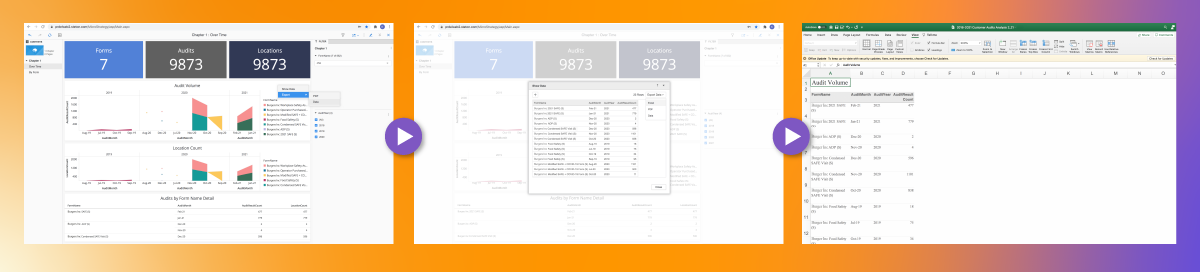
Remember, I’m not going to ask you to give up spreadsheets, but there are ways to amplify your efforts by combining spreadsheets with quality management software.
- RizePoint has the infrastructure you need to import, store, connect, and track all your data in one place. It’s fast and easy to find important information and insights, plus there’s no formulas to break. The extra great news is that you can export your data to spreadsheets at any time, so you can digest everything in the comfort of your own spreadsheet software. You can also view data in visually effective dashboards and reports in the platform, or you can use a grid view that’s very similar to a spreadsheet experience.
- Data entry almost becomes a non-issue with our world-class auditing app — Mobile Auditor. The app comes with the platform, and it can handle any data gathering you need, from complex audits to simple checklists. Mobile Auditor is fully integrated, so audit data and results are updated automatically in the system, ensuring that you’re always looking at the most up-to-date data. With a more automated system for data gathering, human error can be greatly reduced. Bonus: Auditors love our user-friendly app!
- Sophisticated reporting and analytics tools are included, so you can access daily, actionable insights via up-to-date data, and you can produce deeper reports within a few minutes in most cases. In addition to the business-specific reports and dashboards mentioned above, our ask-and-answer functionality ensures that on-demand reporting from your boss isn’t a “stop everything and work on a report for a few hours” affair; it’s a matter of asking the right questions to quickly get a complete, accurate report.
- When all your data is stored and tracked in one place, and you can import data from other sources, data management can become a background process rather than an admin activity that requires too much attention. You can easily create holistic views of your entire business, drill down all the way to a single location, or anything in between. And don’t forget, you can export to a spreadsheet whenever you need to.
Our ask-and-answer functionality ensures that on-demand reporting from your boss isn’t a “stop everything and work on a report for a few hours” affair; it’s a matter of asking the right questions to quickly get a complete, accurate report.
With more standards bodies and government entities working toward digital submission processes, and with the fallout from COVID-19, it’s clear that everyone is moving to more modernized quality management systems and programs. But you don’t have to give up quality management with spreadsheets to modernize. Pairing your well-loved spreadsheets with quality management software, like RizePoint, means you can keep the comfort of your spreadsheets while making your programs more modernized and efficient.
As president of RizePoint, Kari Hensien will never stop using spreadsheets. However, as a champion of continuous quality and modernizing quality programs, she is driven to help people keep their brand promises more efficiently in a way that is comfortable for quality managers. You can contact her at kari.hensien@rizepoint.com.

by Kari Hensien | Feb 2, 2021 | Document Management, food safety culture, Quality Management System, RizePoint, Self-Assessments, Supplier Quality Management
The world for quality management is changing dramatically. Supply chains are more complex, poor customer experiences can go viral in minutes, and COVID-19 has created a number of new potential risks and liabilities.
However, while the pandemic has surfaced new concerns, it did not cause these challenges for quality teams. Instead, they are the result of decades of technological innovation, evolving workplaces, and updated regulations.
Fortunately, these challenges are solvable. You can elevate quality and safety protocols with a few adjustments to the way you work, and to the tools that help you manage it all.
1. Make self-assessments a regular part of your quality data gathering.
Many businesses see self-assessments as something akin to an open-book test. Not technically cheating, but not as good as a test that required hours of study. We want to reframe that perception.
Increasing the frequency of self-assessments is a critical part of obtaining full visibility into your quality and safety goals. Self-assessments are not better or worse than annual or third-party assessments, simply different. They play a unique role in the quality ecosystem by helping you gather daily insights into every location.
Frequent self-assessments not only give you broader visibility, they also reinforce new or existing standards to employees. Empowering employees with knowledge and ownership of their work will help you build a continuous quality improvement model that pulls from multiple sources of data and pushes feedback directly to the places it will most make a difference.
2. Invest in software that enables data gathering and analysis.
Quality teams have struggled for years to find an effective way to compile and make sense of the data they gather. Spreadsheets have been a staple of the role since the dawn of Excel, but they don’t make it easy to collect and report on reams of data.
That is why you should look at a quality management system (QMS). A QMS makes it possible for you to keep what works for you and elevate what isn’t. If you love spreadsheets, but struggle with how disconnected they make your data, you can import the spreadsheets into a QMS and let it make the reports for you. If you want to collect more data but don’t have a way to correlate data from different sources, a QMS is built to help you do that.
If you’re ready to move into a modern quality model, you need something that will help you work better and the technology now exists to enable you.
3. Make food safety culture more than a buzzword.
It’s easy to say you want to change this or that about your culture, but it’s much harder to do so. Self-assessments will be part of helping you do that. Employees who see you care about and monitor food safety protocols are more likely to care as well.
You also need to take employee feedback seriously. Whether that comes in the form of a tipline, a self-assessment, or comments to managers, don’t brush off what employees have to say about food safety. They are the ones who see what the needs are every day. They may be able to point out improvements to the kitchen layout to reduce risk of cross contamination or tell you when a manager is ignoring proper hot and cold storage. It’s your job to listen and turn that feedback into a piece of your continuous safety and quality improvement system.
4. Make electronic updates the norm to improve consistency.
COVID-19 has exposed the weakness in antiquated paper communication with your employees. Too many companies are still using printouts that get missed by a third of employees or aren’t updated when policy changes.
You can distribute updated policies quickly and easily with digital systems. You can give employees accurate, timely updates in times of crisis or as needed, and know you have an effective communications system in place that you can rely on.
5. Modernize your vendor onboarding process.
Being able to quickly vet and onboard new vendors is a crucial to protecting your business during supply chain disruptions. During the pandemic, many companies have found themselves scrambling when key suppliers were out of critical items.
You can communicate with suppliers, avoid approval delays, and gather credentials with digital supplier management tools. All of this helps you ensure any new supplier meets your standards before becoming an approved vendor, and lets you act quickly when disruptions affect your business.
Adapting to the changing needs of quality management is a challenge, but solutions are available. You can start taking concrete steps to update how you collect, analyze, and communicate data. A quality management system will help you lay the foundation for a continuous quality management model, so you can keep what is tried and true for your team (like our beloved spreadsheets!) while getting help with the areas that give you trouble.

by Kari Hensien | May 12, 2020 | COVID-19, Quality Management System
It’s hard to overstate the impact of COVID-19. Seemingly overnight, businesses across industries have had to adapt to fluctuating work practices, diminishing sales, and volatile markets. The truth is, “business as usual” no longer exists. Like it or not, now is the time to adjust to our new normal. And finding effective COVID-19 solutions is the first step.
Your job is more crucial to the success of your company than ever before. In the coming months, you’ll likely be expected to implement new safety protocols and foster an intensified safety culture. Quality management software (QMS) can help you make that happen.
Below, you’ll find three key benefits of leveraging QMS to manage your quality program, during the pandemic and beyond.
Benefit #1: Build a Consistent Safety Culture
Quality management doesn’t take place in a vacuum. To effectively do your job, you need to manage stakeholders both inside and outside of your company’s walls. Without their buy-in, you’re unlikely to make progress.
Stakeholders are equally important when fostering a safety culture. But without the right tools, it’s painstaking work. From establishing new protocols to delivering consistent messaging, you’re stuck doing everything manually, which eats up your time.
Quality management software (QMS) makes it simple to roll out new policies and guidelines across your company and all store locations, ensuring no stakeholders are missed. Plus, centralized documentation that’s readily available to your suppliers helps extend your safety culture outside your walls. It also ensures your messaging is consistent from stakeholder to stakeholder, which strengthens your safety culture.
Benefit #2: Put Customer Health & Safety First
Every industry is affected by COVID-19, but those that rely on in-person contact with their customers are especially vulnerable. If you work for a restaurant or hotel, for example, you’ll need to increase your sanitation efforts and demonstrate your commitment to customer safety to rebuild their confidence.
Quality management software (QMS) can help you organize and build a quality management system that highlights customer health and safety. It allows you to prepare for new standards in quality, safety, and compliance, and seamlessly communicate changing protocols across multiple stakeholders and locations. Informed and empowered employees go a long way toward boosting customer confidence.
Benefit #3: Assess, Monitor & Report on Quality
Our new reality is sure to bring an uptick in assessments, inspections, and audits. Combined with your existing workload, this will make it impossible to use spreadsheets to manually track quality concerns.
Quality management software (QMS) can help you succeed. Not only can you monitor quality through centralized, standardized, and easy-to-run reports, but you can conduct remote audits across every location of your business. Plus, you can gain access to useful tools like COVID-19 audit checklists built by industry experts.
Looking for an auditing and quality management solution for your business? See how RizePoint empowers you to track, verify, and scale all your quality and safety programs.

by Kari Hensien | Mar 28, 2019 | Quality Management System, RizePoint
How to Make Sense of Your Data with Quality Management Software
Data, data, data is the mantra of modern business. From operational data to customer feedback, companies are collecting all the information they can to glean insights to improve their businesses and the bottom line.
As someone who manages quality programs, you need to gather and analyze a lot of data to ensure compliance of brand and regulatory standards. You may still be using manual methods or working toward completely digitizing all your data collection methods. Either way, you still have incredible amounts of raw data that you need to organize and analyze to find meaningful insights.
It’s clear that data is important to driving business improvements, but collecting data just because you know you need to collect data can leave you drowning in too much of a good thing. The key is gathering and analyzing data that’s important to your unique KPIs and other business needs. That’s where the right quality management software platform comes in — to help you gather better data, see more insights with built-in analytics, and act quickly and appropriately with the results.
Automating Data Collection
In the past, manual data collection was enough for most businesses. But modern business practices need to move at the speed of technological advances in order to mitigate risk and keep a competitive edge. Data collection with pen, paper, and spreadsheets can no longer keep up with the amount of information required to run comprehensive quality programs.
Fortunately, tools that help digitize and automate data collection already exist. Quality management software (QMS) is a tool that can speed up data collection during audits and inspections. One of the major advantages of a comprehensive QMS is that it creates a single source of truth for all your quality-related data. Additionally, in manufacturing, processing, and distribution, your internet of things (IoT) — including smart scanners, scales, digital thermometers, programmable logic controllers (PLCs), and more — can be connected to many QMSs and, by extension, your single source of truth. This automation of data collection not only saves a large amount of time; it also offers real-time visibility into your programs so you can proactively mitigate risk.
That’s tempting enough for many quality leaders to switch to a QMS. However, there are software solutions that go way beyond data collection.
Turning Data into Meaningful Insights
While collecting as much data as possible might sound appealing in the abstract, it’s not always helpful unless you have a process or system to help you organize and analyze the data you collect. If you’re collecting thousands to millions of data points every day, it’s an arduous task to manually compile results and build the different reports necessary for all the stakeholders in your company — from the floor managers to the CEO.
This is where a robust QMS with built-in analytics and reporting tools can make a huge difference to your quality programs and processes. These types of tools are must-haves in a QMS to help you compile meaningful business intelligence and gain real-time visibility into your quality programs. The right QMS for your business may also include dashboards and configurable pinboards that help you see your data in new and helpful ways. Looking at your data in different ways via filters and pinboards can help you spot trends and proactively make decisions that are specific to your unique KPIs and risk mitigation efforts.
For more tips on discovering the right QMS that will keep you from drowning in data, check out the article
“Does Your Quality Management Solution Have These 4 Essentials?”
___
RizePoint is a quality management software that empowers quality teams to analyze meaningful data and drive improvement. Request a free demo at RizePoint.com.
